
Learn Bubble Craps.
From your first roll to understanding the table, explore at your own pace.
Search rules, strategies, articles and learning tools.
Ever wondered why a bet pays what it does, what changes from one machine to the next, or how a strategy actually behaves? Start wherever you’re curious.
Featured collection
Strategy guides
Explore different approaches, see how they work and understand their trade-offs.
Explore by topic
Browse all articles and strategy guides →
Try an interactive experiment
- Why one session tells you so littleCompare archived virtual dice with their mathematical expectations.
- Why playing speed mattersCompare how different playing speeds change the number of rolls in a session.
- Do casino rewards cover the cost?Compare assumed rewards with the theoretical cost of wagering.
- Winning sessions aren’t the whole storySee why the size of wins and losses matters more than the win rate.
Search results
Try a wager name such as Lay, Field or Lucky Shooter. Or clear the search to browse topics.
How Bubble Craps works
The puck tells you more about the game than the last roll alone.
You can sit down at a machine in the middle of a hand and see the puck sitting on the 8. That tells you the table is waiting for an 8 or a 7 to settle any established Pass Line bet. But there may be other bets doing something entirely different. Let’s follow the table through one cycle.
On a Traditional table, a 7 or 11 wins the Pass Line straight away. A 2, 3 or 12 loses. Any of the six numbers below becomes the point.
Once the puck is ON, the Pass Line waits for that number to come back. Other bets may win or lose along the way; the table point stays put.
Make the point and the Pass Line wins. Roll a 7 first and it loses. Either way, the puck goes OFF. A seven on the come-out is not a seven-out.
The part that can catch you off guard is that not every bet follows the puck. Come and Don’t Come bets can establish numbers of their own, and making the table point does not automatically settle those bets. On a conventional bar-12 table, Don’t Pass and Don’t Come win on 2 or 3 when they are first rolled, push on 12 and lose on 7 or 11. Once they have a number, they win if a seven arrives before that number.
See it in action
See the puck and point in Table Explorer. Use a reviewed virtual example to follow the point cycle, or record a continuous roll log to see the difference between sevens and seven-outs.
Open the Pass Line + Odds lesson · Record rolls in Session Tracker
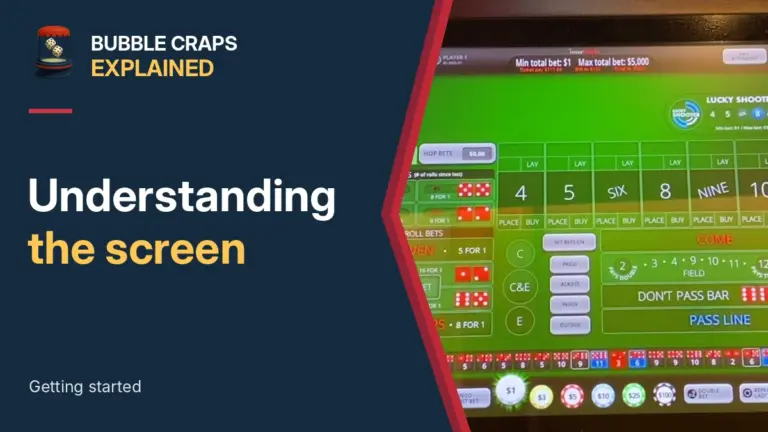
Read the full beginner guide · Understand the machine screen
How do we know this? 4 references
- Interblock game description v2.5.1Washington cabinet baseline, pp. 5–13; conflicting dark-side tables are reconciled using the next two sources.
- Interblock Roll to Win overview v1.12025, p. 21; corroborates established dark-side settlement.
- Clearwater electronic craps rules2024, §§15–20; electronic game settlement.
- Maryland standard craps rules v1.5Ch. 3, pp. 5–7; live-table comparator.
Traditional Craps payouts & odds
The same number can pay differently depending on which bet you have on it.
Ever looked at a $6 Place 6 bet and wondered why it pays $7 rather than $6? The payout depends on the type of wager, not just the dice total. The table below uses profit odds: your original wager is separate. If a screen says “for 1,” that includes the returned stake instead.
| Number | Place | Take odds / Buy | Give odds / Lay |
|---|---|---|---|
| 4 / 10 | 9:5 | 2:1 | 1:2 |
| 5 / 9 | 7:5 | 3:2 | 2:3 |
| 6 / 8 | 7:6 | 6:5 | 5:6 |
Line bets and odds
A $5 winning Pass, Come, Don’t Pass or Don’t Come bet earns $5. True odds pay in proportion to the chance of winning, without a mathematical house edge before fees or rounding. The original line bet still has its own house edge.
Hardways & Big 6/8
A hard 6 needs two threes, not just any six. The double has to arrive before a seven or an easy six. Hard 4/10 pay 7:1 and hard 6/8 pay 9:1 in this model. Big 6/8, when offered at even money, simply need their number before seven.
One-roll wagers
Field wins on 2, 3, 4, 9, 10, 11 and 12; 2 and 12 bonuses vary. Any Craps commonly pays 7:1 and Any Seven 4:1. Individual 2/12 commonly pay 30:1 and 3/11 15:1.
Horn & C&E
Horn splits stakes across 2, 3, 11 and 12. With conventional individual payouts, the net result is 6.75:1 on 2/12 or 3:1 on 3/11. A common combined C&E pays net 3:1 on craps or 7:1 on eleven. Check the displayed convention.
Here’s where the credit meter can be confusing: a winning $6 Place 6 earns $7, but the original $6 may stay on the table. You may see $7 added to available credits, not $13.
Explore the betting layout and payout examples
Explore these wagers
Lay 4 explained · Buy 4 explained · True odds explained · Field explained
Explore the table layout · Open the Place 6/8 lesson · Open the Don’t Pass + Odds lesson · Open the Come and Odds lesson
Guided examples use the traditional practice model; they open with the named example selected. Buy and Lay are available in Free Play, not as dedicated guided examples.
Try a Place 6 outcome
Assume a working $6 Place 6 wager at 7:6. Select an outcome.
6: $7 profit; the original $6 can remain in play.
7: lose $6. 9: no settlement. This is a conditional example, not a prediction.
How do we know this? 4 references
- Rivers Philadelphia Interblock gaming guideStadium craps, pp. 2–4; traditional payouts and odds.
- Interblock v2.5.1Washington machine description, pp. 11–19; available wagers and Field alternatives.
- Resorts World Sentosa rules v5Effective August 2026, pp. 9–10; live-table payout comparison.
- Maryland standard craps rules v1.5Ch. 5–6, pp. 20–28; traditional payouts and supplemental wagers.
Traditional, Crapless or Easy?
The machines can look almost identical, but the Pass Line plays differently.
If you’ve played Traditional Bubble Craps for a while, Crapless can look like a friendlier version: no immediate Pass Line loss on 2, 3 or 12. The catch is that those numbers become points, and so does 11. That changes the math considerably. Easy Craps uses the same opening rules as Crapless, but offers a shorter menu of bets.
Traditional
6Possible points
7 and 11 win immediately on the Pass Line. Dark-side bets and Come are available in the documented model.
Crapless
10Possible points
Only 7 wins immediately. All other totals become points. Come is available; the Interblock profile omits Don’t Pass, Don’t Come and Lay.
Easy
10Possible points
Same Pass opening rules as Crapless. The documented profile removes Come, Don’t Come, Don’t Pass, Buy and Lay; adds Low and High Field options.
These are the mathematical house edges on the initial even-money Pass bet, assuming fair, independent dice. Removing the immediate losses sounds helpful, but the overall Pass bet costs more on average.
Crapless gives you some unfamiliar number bets. True odds on 2 or 12 pay 6:1, and on 3 or 11 pay 3:1. Place payouts on those numbers can vary, so don’t assume your usual machine’s paytable applies. Easy Craps also adds Low Field (2, 3, 4) and High Field (10, 11, 12).
See documented paytable differences
Nevada and Maryland examples use 5:1 and 13:5 for those Place payouts, while Pennsylvania’s published schedule uses 11:2 and 11:4. Nevada also documents an optional Lay wager. Low and High Field paytables differ.
Read the Crapless guide · Read the game overview
Compare the games
Read the Crapless Craps guide · Explore electronic craps options
Record rolls in Session Tracker (choose the actual game and known starting point). The simulator currently models Traditional Craps only.
How do we know this? 4 references
- Interblock game description v2.5.1Washington baseline, §§1.3.1–1.3.2 and pp. 5–17.
- Pennsylvania Chapter 623b§623b.6–7; February 2026 compilation, Crapless and Easy rules scheduled through Nov. 15, 2028.
- Nevada Crapless rules of playp. 1; alternate Place payouts and optional Lay.
- Maryland Crapless rules v1.1Ch. 3, 5 and 6; live-table comparator.
What can change from machine to machine?
A familiar screen does not always mean familiar rules.
Ever moved from one casino to another and found that the machine collects the vig at a different time, or won’t let you remove a bet? That isn’t necessarily a fault. There are real differences between documented game configurations. Here are the settings worth understanding.
- Working bets
- Check whether a bet is working on the come-out. For example, Rivers stadium rules turn Place, Buy, Hardways and Come Odds off by default, but established Come flat bets and Don’t Come with odds stay active. Our practice simulator instead uses a manual working switch that stays where you set it.
- Odds limits
- You may be used to 3-4-5x odds, but some documented machines offer only 2x and others allow higher limits. Don’t-side odds limits may refer to the amount you risk or the amount you can win. The machine’s displayed limit is the one that matters.
- Buy and Lay commissions
- The vig is the fee you pay on certain bets. With a common 5% commission calculation, a $60 Buy 4 costs $3 in fees while a $60 Lay 4 costs $1.50, because the Lay fee is based on potential profit. When the fee is collected, rounding and refund rules can vary.
- Removing bets and opposing positions
- At Rivers, the documented rules allow you to reduce or remove Don’t Pass after the point. Clearwater’s 2025 Shoot to Win rules lock it in. Opposing wagers can also be restricted: a new Come bet alongside a traveled Don’t Come has been observed, but not every machine permits it.
- Controls and credits
- Press, Across and ON/OFF are shortcuts, not changes to the dice odds. If you switch a bet off, remember that chips may still be on the table. Available credits and total equity (credits plus open stakes) are not always the same thing.
Practice profile: Traditional only, 3-4-5x take odds, 6x base stake give odds, nearest-cent payouts, manual working status, configurable Field and fee timing. This is an educational configuration, not a certified or statistically proven nationwide default.
Compare practice assumptions
Explore the table layout · Open Free Play and review its settings. A practice configuration is not a universal machine rule.
How do we know this? 6 references
- Rivers Philadelphia stadium guidepp. 2–4; working defaults, removal and odds limits.
- Clearwater Shoot to Win rules2025, §§11, 16–21; removal and commission treatment.
- Interblock Roll to Win overview v1.1pp. 12, 21–22; configuration and credit presentation.
- Marina Bay Sands Craps v4Effective Oct. 2025, §§3.4.10–11, 3.16–17; upfront vig and live-table comparison.
- Interblock v2.5.1pp. 9–10, 15, 20–22; machine restrictions and controls.
- The Rookie Gambler — Arnold machine footageObserved player footage, not official rules; configuration and firmware unknown.
What makes one strategy different from another?
Some players like to collect, others press their bets, and others prefer to keep only a few numbers working. Those approaches can feel very different over a session. They change how much money is exposed and how often bets resolve, not the probability of the dice. No betting system removes the house edge.
Browse the full strategy library
Guides with linked practice examples
Pick a guide that interests you. Each linked virtual example lets you see the approach in action with virtual credits, where available. The linked lesson opens with its starting wagers prepared. You decide when to roll.
- The Arnold Craps Strategy · Open reviewed example
- Bubble Craps – Power Pressing Craps Strategy · Open reviewed example
- The Iron Cross for Bubble Craps: Bubble Craps Strategy · Open reviewed example
- Three Point Molly · Open reviewed example
- Place 6/8 Strategy · Open reviewed example
- The Martingale Craps Strategy · Open reviewed example
- 5 Count Craps Strategy · Open reviewed example
- Pass Line + Odds Strategy · Open reviewed example
- Don’t Pass + Odds · Open reviewed example
- Bubble-Craps.com Beginner Baseline · Open reviewed example
Special bets: similar names, different rules
The bonus display may look familiar, but the winning conditions can be very different.
Those extra betting areas on the machine can be confusing, especially when the names sound alike. Lucky Shooter and Lucky Roller, for instance, both involve collecting numbers, but a repeat can matter very differently. Here’s what to look for. These optional bets aren’t available in our current Traditional practice engine.
Lucky Shooter
Lucky Shooter starts before the come-out. In the documented rules, a 2, 3 or 12 at entry loses. Once you establish a point, you need the other five box numbers on consecutive rolls. A repeat or other nonqualifying roll ends the sequence. For the top award, the original point must come back on the sixth roll after the point.
What if a 7 or 11 appears before a point? Published Pennsylvania and Clearwater rules describe a listed payout while the bet stays working, but the manufacturer’s wording conflicts. Check the machine’s actual paytable and credit treatment.
Lucky Roller / Dice It Up
Think of this as filling in a set of numbers before a seven: low (2–6), high (8–12), or all ten non-seven totals. Unlike Lucky Shooter, repeating a number doesn’t end the collection. Names, entry timing and payouts differ, and Nevada’s documented Dice It Up is nonprogressive.
Hot Shooter
Hot Shooter counts rolls according to its own rules, rather than simply counting consecutive non-sevens. Pennsylvania’s documented schedule returns the stake at 8–15 rolls and has a top tier at 50 or more. Check what your machine counts and pays.
Power Odds
In the documented Power Odds version, selected eligible payouts can increase after betting closes, for that roll only. We don’t have the selection probabilities, so we can’t reliably calculate its overall house edge.
Read the full explanation
Open Lucky Shooter in Table Explorer · Open Lucky Roller in Table Explorer
Lucky Shooter: rules and examples. Special wagers are not simulated in the current practice model.
How do we know this? 7 references
- Pennsylvania Chapter 623c§623c.2 and §623c.4; Lucky Shooter and Hot Shooter schedules.
- Interblock Lucky Shooter v1.5.12024, p. 2; conflicting pre-point text.
- Clearwater electronic craps rules2024, §23; Lucky Shooter corroboration.
- Interblock Roll to Win overview v1.12025, p. 23; Lucky Roller, Hot Shooter, Power Odds.
- Nevada Dice It Up rulesp. 1; distinct collection and alternative paytables.
- Colorado commission packetOct. 2025, PDF p. 30; proposed Lucky Roller entry restriction, not a claim of current legal status.
- Pennsylvania Chapter 623b§623b.5 historical Power Odds text, printed expiry Sept. 23, 2026; current status not established.
Are the dice random?
A fair game doesn’t necessarily mean a profitable one.
A few sevens in a row can make you wonder whether the machine knows something you don’t. It’s a reasonable question when you’re watching dice bounce around inside a glass dome. But the way the dice are generated, how often a number appears, and how much a bet pays are three different things.
What happens when you press Roll?
Not every electronic craps machine produces a result the same way. Here are three documented formats.
Physical dice
Real dice move inside the machine. It reads the result and settles the bets electronically.
Virtual dice
Software generates the dice result and the machine settles the bets.
Dealer-assisted
In documented live modes, physical dice are rolled and a dealer enters the result for electronic settlement.
Why does seven seem to show up so often?
There are six ways to make a seven, but only one way to make a two or a twelve. With fair, independent dice, seven is the most common total. That doesn’t mean the machine is choosing it to take your bets.
How many ways can each total roll?
Out of 36 equally likely ordered dice combinations.
Random doesn’t mean evenly spaced. Sevens can appear back-to-back, and a number can go missing for a long time. Past rolls don’t make a number due. A short losing streak alone doesn’t establish manipulation.

What do the dice actually look like?
Reveal the first roll, then watch the chart grow. Compare the observed totals with what fair dice would produce on average.
Show actual dice pairs
What should I notice?
Seven has six of the 36 equally likely ordered dice pairs. That is an expectation of one in six rolls, not a schedule. A short sample can have too many or too few sevens without anything unusual happening. Even a larger sample does not prove that a particular machine is fair.
What if something really seems wrong?
Seeing physical dice or reading about a machine patent doesn’t guarantee that a particular machine is working properly. If you see an apparent malfunction or a disputed payout, stop playing. Note the machine identifier and the result and speak with casino staff or the regulator.
Read our engineering and fairness analysis
Read the engineering explanation
Is Bubble Craps rigged? · Understanding fairness · Machine types
Record rolls in Session Tracker to compare recorded totals with expected frequencies. A short sample cannot prove fairness or manipulation.
How do we know this? 5 references
Michigan’s electronic gaming device rules specify conventional live-game probabilities for recognizable games unless an approved exception is disclosed. Singapore’s 2026 tumbler standards require equal face probabilities, statistical independence and unpredictability for covered physical tumblers; the standard is expressly limited to live and semi-automated environments there. Neither document establishes compliance of a particular US standalone cabinet.
- Interblock Roll to Win overview v1.1pp. 3, 17; different physical and virtual modes.
- Massachusetts Automated Craps rules2018, pp. 1–3; sealed physical dice and dealer supervision.
- Michigan Casino Gaming Rules2026, p. 103 (16)(c),(j); scope is covered electronic devices.
- Singapore electronic dice tumbler standards v1.0July 2026, §§1.2, 2.3–2.4, 3.1; limited scope and recognition requirements.
- GLI standards indexGLI-24 v1.3, §2.13 and GLI-25 v1.2; technical standards, not proof of machine certification.
Why settings differ between machines → · More articles & insights →
Related articles
Articles & insights
There’s more to Bubble Craps than the layout. Why do machines look different? Where did the game come from? What’s behind those unusual bets? These are some of our favorite deeper reads, whether you’re new to the bubble or have been playing for years.
Browse all articles and strategy guides
Strategies
 The ArnoldUnderstand the example’s combination of Pass Line, Don’t Come and Come wagers.
 Power pressingExplore how increasing wagers after wins changes exposure.
 The Iron CrossExplore how the Field and Place bets work together in this example.
 Three Point MollySee how multiple contract wagers can build up over a hand.
 Place 6/8Explore an example centered on the Place 6 and Place 8 wagers.
 The MartingaleUnderstand the risks of increasing stakes after losses.
 The 5 CountExplore how waiting for a sequence of rolls affects betting activity.
 Pass Line + OddsUnderstand the basic contract wager and its optional odds.
 Don’t Pass + OddsExplore the opposing contract wager and its optional odds.
 Beginner BaselineExplore a reviewed virtual practice example for learning the game.
Getting started
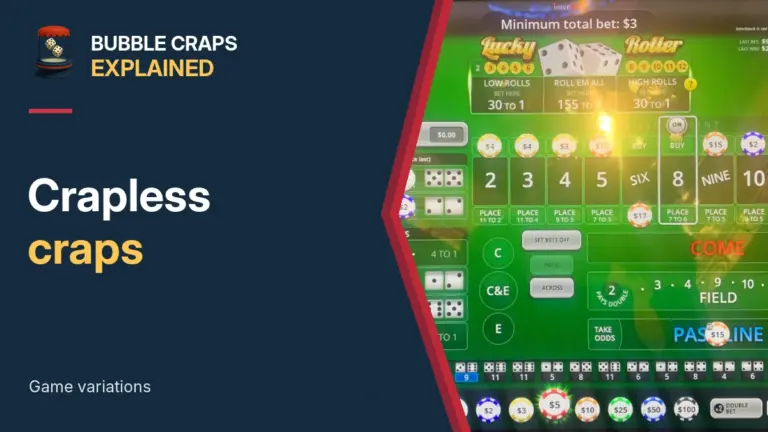
Game variations
Special bets
Machines & fairness
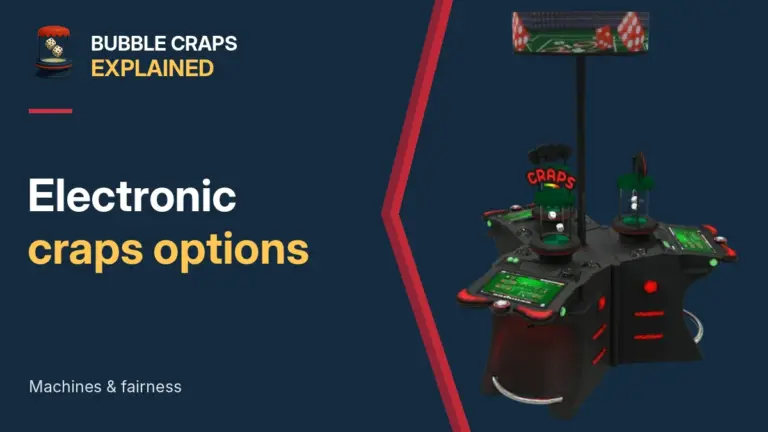 Electronic craps: machine optionsExplore individual, shared and other electronic craps setups.
 Are Bubble Craps fair?Understand the difference between fair dice and the house advantage.
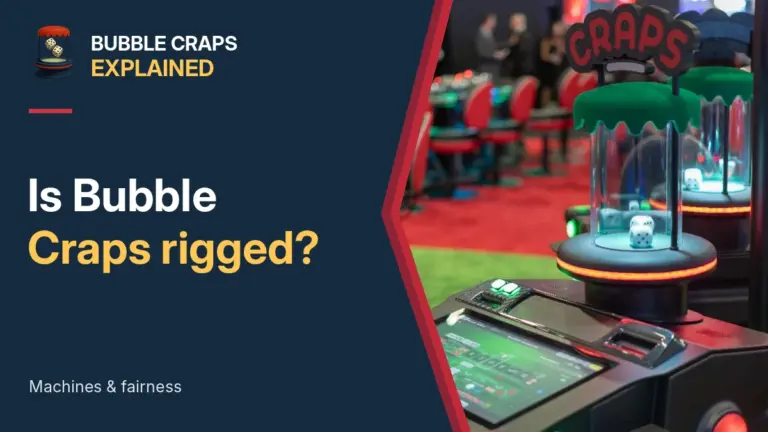 Is Bubble Craps rigged?Explore the engineering questions behind electronic craps and what evidence can establish.
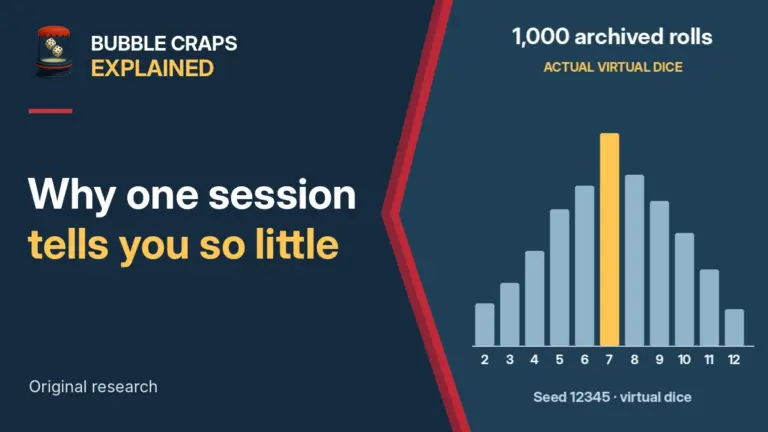 Interactive experimentWhy one session tells you so littleCompare archived virtual dice with their mathematical expectations.
Articles & insights
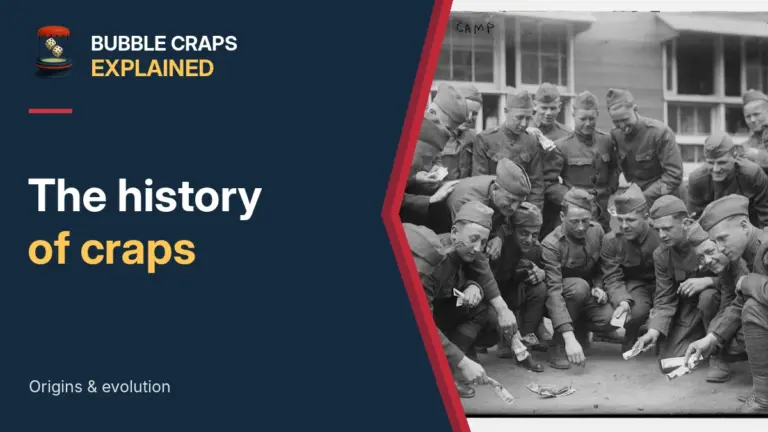 The history of crapsFollow the game’s origins and its evolution into modern casino craps.
 The evolution of Bubble CrapsExplore how electronic craps developed from traditional tables.
 Bubble Craps for introvertsConsider the differences between individual electronic play and a traditional table.
 Interactive experimentWhy playing speed mattersCompare how different playing speeds change the number of rolls in a session.
 Interactive experimentDo casino rewards cover the cost?Compare assumed rewards with the theoretical cost of wagering.
 Interactive experimentWinning sessions aren’t the whole storySee why the size of wins and losses matters more than the win rate.
Practice and track your play
Sometimes the easiest way to understand a bet is to see it happen. Our free tools let you explore the layout, practice with virtual credits, or keep an honest record of your real sessions. Guided lessons are separate from your saved Free Play session. You decide when to roll.
Learn the layout
Explore guided practice
Browse guided practice or find a strategy guide and its linked lesson.
Try the existing strategy quiz.
Record a real session
Record rolls in Session Tracker . Record your roll totals, buy-ins and cash-outs so you can see how a session actually went. Totals alone won’t tell you whether a roll was a hardway. To follow point changes, start with a known table state and keep the roll log continuous.
How we research the rules
Where our explanations come from, and where the evidence ends.
We want you to know why we say something, especially when the rules differ from the machine you normally play. We start with the documentation, compare it with published casino rules and check the mathematics. Where sources disagree, we say so.
Our starting point for cabinet features and settlement.
Independent checks of actual offered configurations.
Jurisdiction-specific rules and technical requirements.
Reproducible probabilities and clearly labeled machine observations.
Start with the common rules, then explore the differences. Our general educational model uses Interblock documentation as its foundation, supported by casino rules, published regulations and dice mathematics. There is no single global cabinet configuration; check the actual machine’s help screen and paytable.
We reviewed relevant portions of 26 original PDFs in our private research collection (November 26, 2026). We preserve document versions and scope, distinguish observed play from official rules, and use original explanations. Links above go to the publisher or regulator; we do not republish restricted manuals. Some older approvals and paytables may no longer apply. Proprietary par sheets and Power Odds trigger probabilities remain unavailable.
Where reliable sources disagree, we explain the difference instead of choosing a universal rule without evidence. The simulator and tracker are independent educational tools, not certified gaming products. Simulated results do not predict casino outcomes.
Suggest a factual correction · Explore the virtual practice model
Include the affected page, game or machine, and the source or dated observation. Do not send financial or account details.