
Ever had an afternoon when it seemed like seven was the only number the machine knew? Or a long run without a seven? Both can happen with fair dice. The tricky part is that randomness rarely looks as tidy in a short session as it does in a probability chart.
Let’s look at some actual virtual rolls
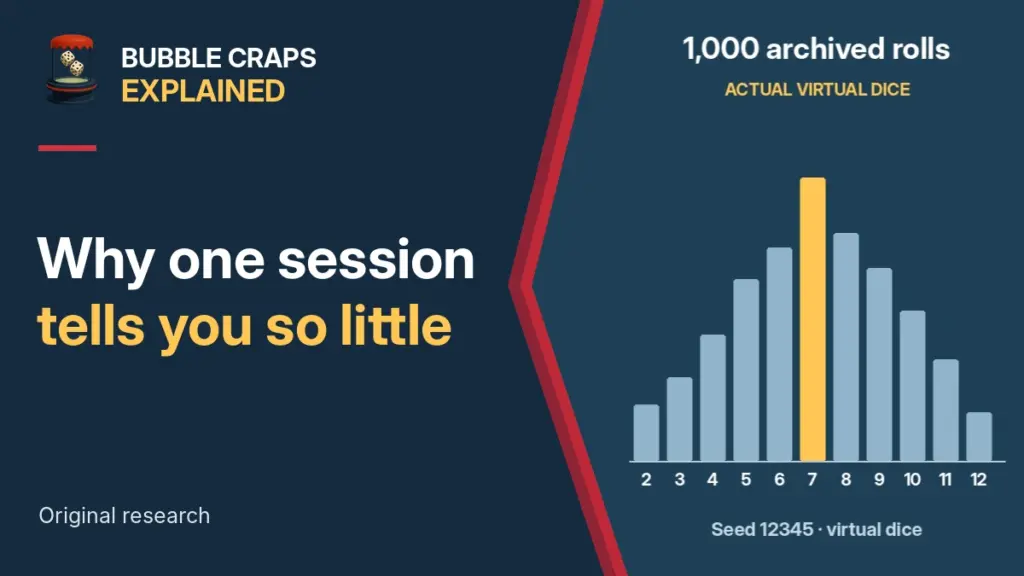
We saved the dice sequences used in our original strategy research. The example below shows a fixed prefix from those sequences, not handpicked wins or losses. Change the sample size and compare what actually appeared with what the math predicts.

What do the dice actually look like?
Reveal the first roll, then watch the chart grow. Compare the observed totals with what fair dice would produce on average.
Show actual dice pairs
What should I notice?
Seven has six of the 36 equally likely ordered dice pairs. That is an expectation of one in six rolls, not a schedule. A short sample can have too many or too few sevens without anything unusual happening. Even a larger sample does not prove that a particular machine is fair.
What would count as evidence?
A streak is a description of what already happened. The next independent fair roll still has the same distribution. Even if seven appears less often than expected in the first 100 archived rolls, there is no mathematical requirement that the next few rolls make up the difference.
The fixed archive lets anyone examine the same sequence. It is useful for comparing observation with expectation, not for diagnosing a casino machine. For that, you would need data from the actual machine, a documented collection process and an appropriate statistical analysis.
A good run does not prove a strategy works
A strategy can have frequent winning sessions and still lose credits on average if the losing sessions are larger. Look at the whole distribution, including losing and break-even sessions, not only the most memorable results. Our strategy guides can include reviewed 1,000-session reports and the corresponding recorded replays.
Likewise, a deviation from expected dice frequencies in a short sample does not establish manipulation. These virtual dice are not a test of a particular casino machine. They also do not predict the next roll.